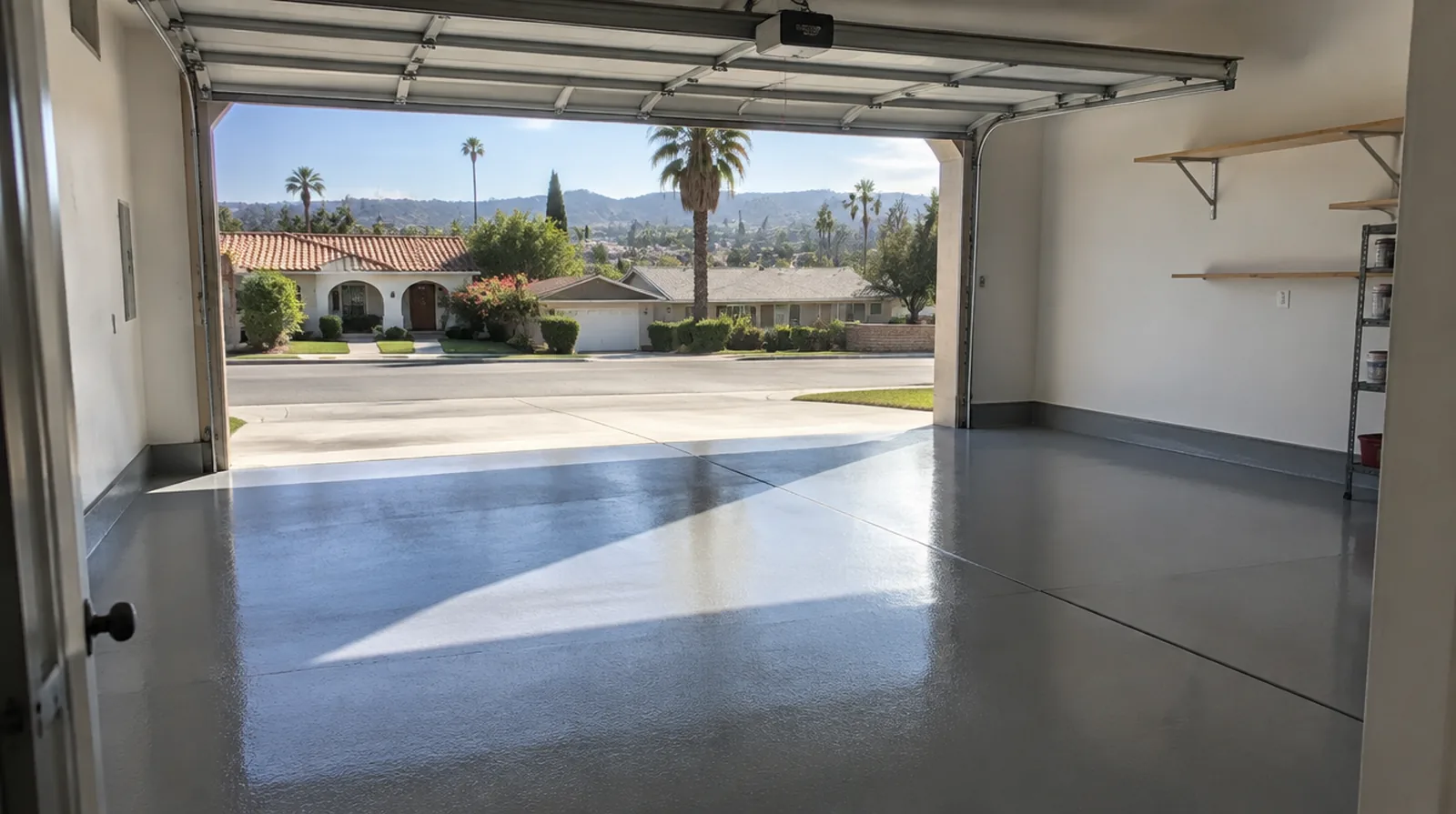
Older garages
Thin, cracked slabs get extra repair. We fill cracks, patch spalls and sometimes level low spots. Thresholds are detailed carefully where old slabs meet driveways.
Newer garages
Smoother slabs still get full grinding to open the surface and remove sealers.
The system
Primer, color base, optional chips and a clear protective topcoat.
Hillside water
If water runs into a hillside garage, we discuss drainage options before coating.
Timing
Walk the next day, park in about a week.
Can you coat over old paint?
We remove it first.
Do you level uneven floors?
Within limits, with patching compounds.
Garage floor epoxy across Whittier's mix of eras
The housing stock here spans early twentieth-century bungalows, postwar tracts and newer hillside homes. Garage floor epoxy in Whittier has to fit each. Older detached garages need patching and careful leveling; newer attached garages usually need a moisture check and a tougher system for daily parking.
Can a floor be coated if the old garage has no slab edge?
Some vintage garages have crumbling edges where the slab meets the dirt. We cut back and patch them before coating so the finish has a solid border.
What if my garage door is original and does not seal?
We block gaps during install to keep leaves and dust out of the wet coating, and we recommend a new seal afterward.
Is there an option that looks less glossy?
Yes. Satin and matte topcoats feel more natural with period homes.
Can you coat a garage used as a studio?
Yes. Light colors brighten the space for artwork and crafts.
From grinding to parking
On the first morning we protect walls and doors, then grind the slab with vacuum-equipped machines. Cracks and spalls get filled and smoothed. The primer and base coat go on that afternoon. The next day we add flakes or a solid color, then the clear top. You can usually walk on the floor that evening and park a few days later, depending on the product and the temperature. We give you exact times in writing.
Garages on the hillsides
Homes in the hills often have attached garages with steep approaches. Water and grit run toward the door, so we check the threshold, suggest a texture strip there and look at how runoff moves. If water enters the garage regularly, we recommend sorting that out first so the new floor lasts. A textured topcoat also helps when shoes come in wet from the yard.
Storage after the floor cures
We suggest waiting to install wall cabinets or overhead racks until the floor cures, so ladders and boxes do not mark it.
Filling cracks in an old Whittier slab, step by step
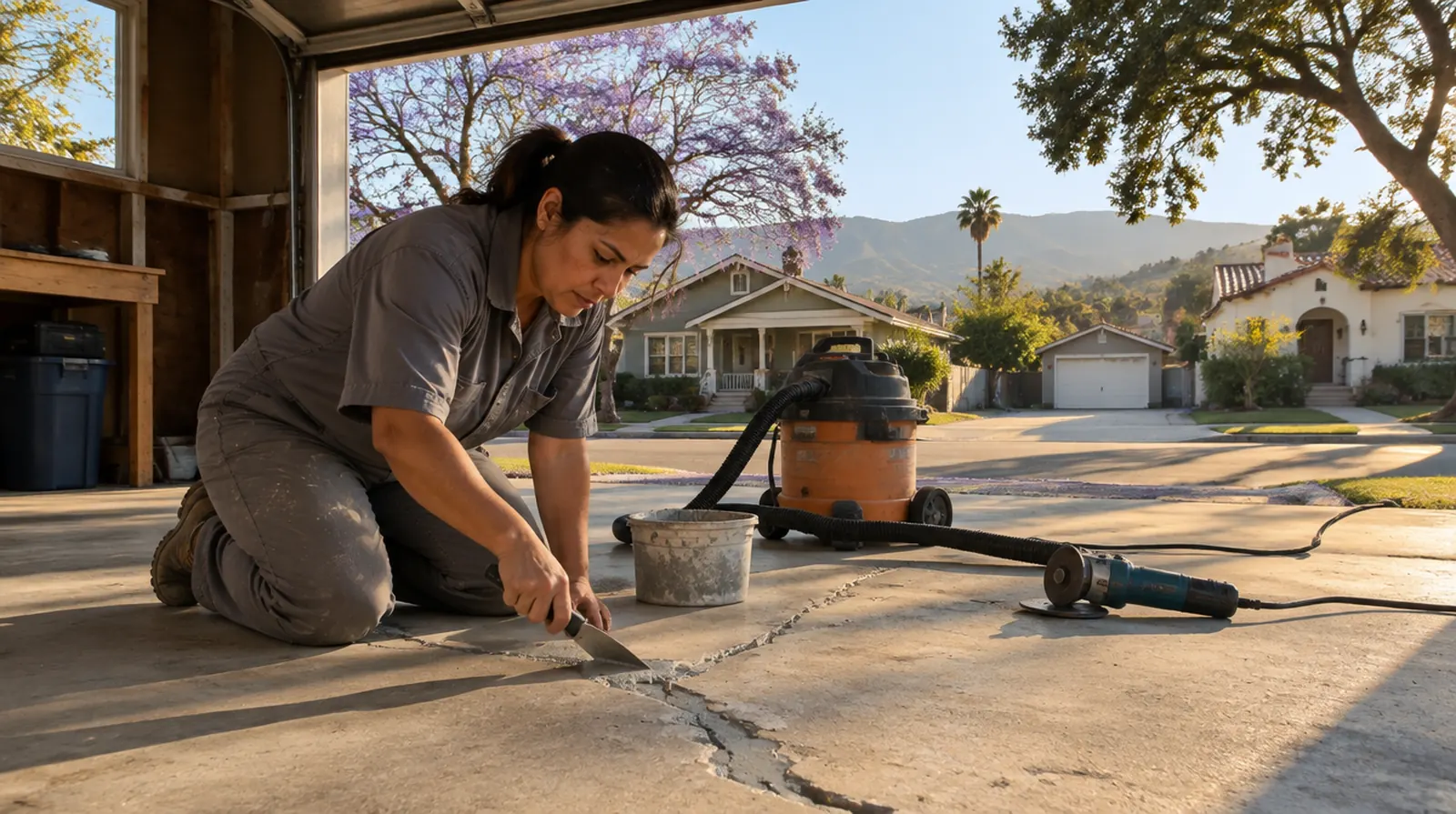
Most garage slabs in Whittier's older neighborhoods have cracks. Some are thin lines from shrinkage. Others have opened up over time from settling, tree roots or the movement that comes with living near active faults. Before any coating goes down, those cracks need attention.
Sorting the cracks
We start by walking the floor and marking each crack. Hairline cracks that are stable get a simple fill. Wider cracks or ones with uneven edges get more work. If one side sits higher than the other, we talk with you about grinding it flatter.
Opening and cleaning
A crack chaser or grinder opens each crack slightly so filler can grip clean concrete. We vacuum out dust and loose bits.
Choosing a filler
Rigid fillers work well in stable cracks. Flexible fillers are better where some movement is likely. We explain which one we plan to use and why.
Leveling the patch
Once the filler sets, we grind it flush with the floor so it does not show as a ridge under the coating.
Pits and spalls
Old slabs also have pits, chipped edges and worn spots. These are filled and ground the same way.
Setting expectations
A filled crack will often show faintly through solid colors. Flake blends hide repairs much better. If a crack keeps moving, it may reappear over time, and we will tell you that up front.
Then the coating
With the repairs done, we apply the base coat, any flake and the topcoat. The repairs become part of a smooth, sealed floor.
Get a garage estimate
Call (562) 457-6982.